DR. DEPAEPE
1. WHAT
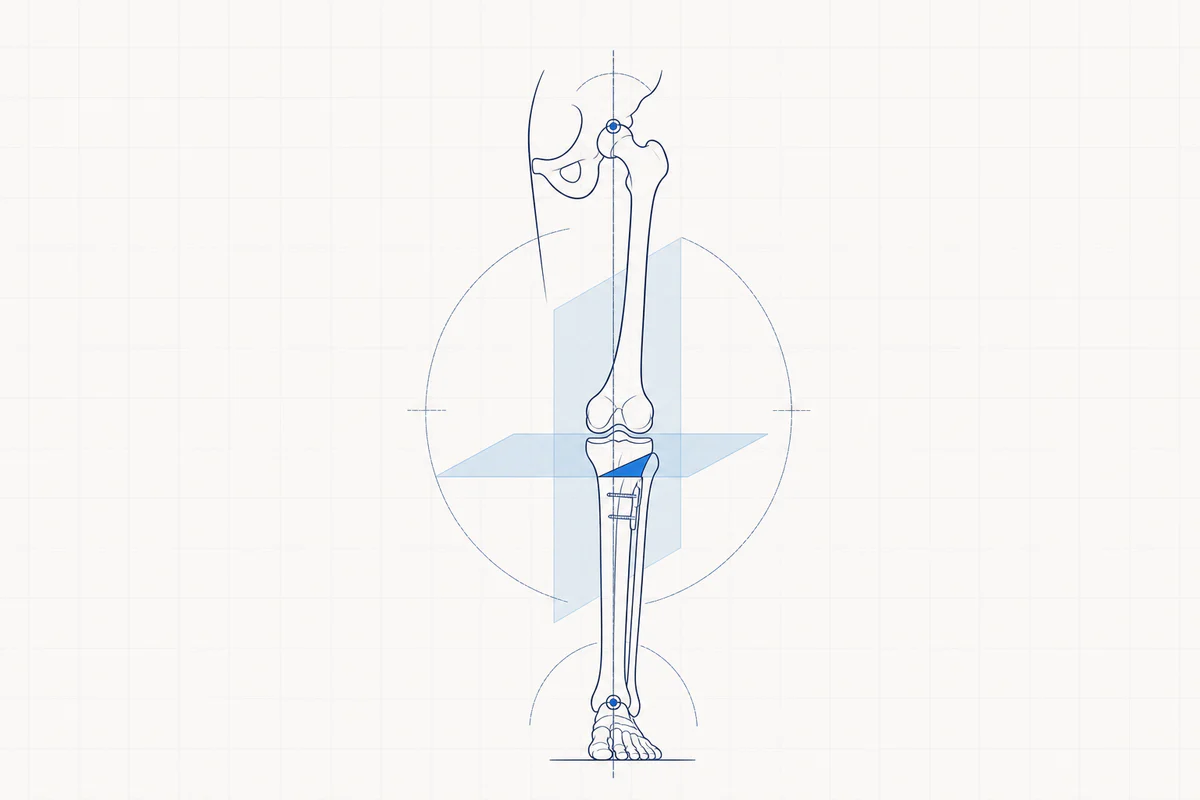
A tibial osteotomy is a procedure on the lower leg just below the knee that is performed to correct the axis of the lower limb ('osteotomy' means 'cutting the bone').
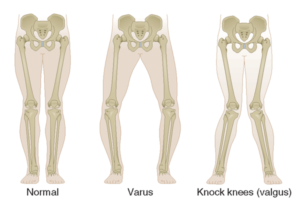
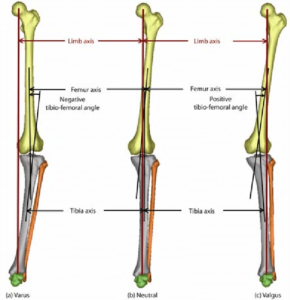
With a normal “straight” knee, the load on the knee runs through the middle of the knee. If there are axis deviations, the axis of load runs too much inwards (O-leg) or too much outwards (X-leg).
Patients with axis abnormalities in the legs can develop premature cartilage wear or osteoarthritis on the inside of the knee (bow-legs) or on the outside of the knee (x-legs).
The purpose of an osteotomy is to reduce pressure on the painful side of the knee (usually the inner compartment). By correcting the axis of the lower leg (tibia), the force shifts to the non-painful side of the knee where the cartilage is still intact. This intervention can slow down the evolution towards further wear and tear.
2. CAUSE of the axle deviation
- A congenital axis abnormality, often increased by premature cartilage wear.
- Previous surgery: e.g. complete removal of the inner or outer meniscus.
- A previous fracture that has healed in an abnormal position.
3. INDICATIONS FOR INTERVENTION
- Early osteoarthritis of one part (or compartment) of the knee in patients with an axis deviation. This means that the other parts (compartments) of the knee are completely undamaged.
- Young (< 60 jaar), actieve patiënten (fysiek werk, sporters), waarbij plaatsen van een knie prothese nog te vroeg is. Soms kan op die manier de leeftijd voor het plaatsen van een prothese uitgesteld worden.
4. RESEARCH
- Radiography of the knee.
- Radiography of the entire leg (full leg) to measure the leg axis.
- Arthro CT scan or MRI scan to document cartilage damage.
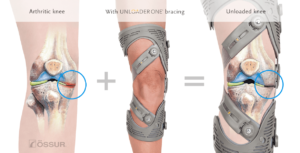
- Unloader brace. Meestal wordt er voor de operatie een speciale kniebrace gedragen die het effect van de operatie kan nabootsen. Deze unloader brace zal de druk in het aangetaste compartiment van de knie verminderen en de druk verplaatsen naar het gezonde compartiment van de knie. Als de patiënten een goed resultaat bekomen met deze speciale unloader brace zijn ze goede kandidaten voor de operatie.
5. THE OPERATION
During the procedure, a surgical fracture is created in the leg in a controlled manner.
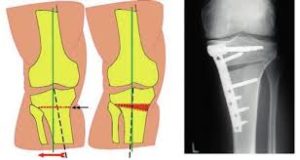
This fracture is then used to correct the axis of the lower limb to the desired position. The fracture can be stretched open along one side (=opening wedge osteotomy) or a triangular wedge or wedge can be removed and the fracture closed afterwards (=closing wedge osteotomy).
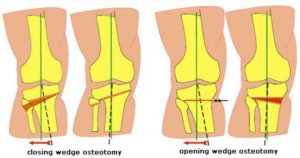
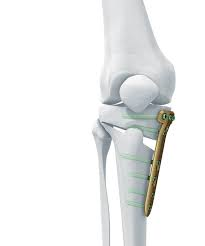
After repeated checks with the RX device, the created fracture is secured with a plate and screws.
Which type of osteotomy is chosen depends on the type of axis deviation (o- or x-leg) and the location of the axis deviation (upper leg or lower leg).
ANESTHESIA AND HOSPITAL STAY
The procedure is performed via an overnight stay and can be performed via an epidural or short general anesthesia.
6. COMPLICATIONS
- Bleeding in the knee after osteotomy. Frequent ice applications can help with this.
- The wound sometimes remains sensitive for a long time after the osteotomy.
- A thrombosis or pulmonary embolism may occur. This risk is avoided by injections in the abdomen during the first period in which support is not possible.
- Infection of the wound or metal plate. Good wound care at home is essential!
- The removed bone does not heal after the osteotomy (e.g. in intensive smokers).
- After healing of the osteotomy, the plate can sometimes cause irritation. In these cases, the plate can be removed via a minor procedure.
- Damage from osteotomy surgery to structures around the knee, such as nerves or blood vessels; this is very rare.
7. REHABILITATION
The exercise therapy is intensive and long-lasting!
After the procedure, you may immediately move (bending and stretching) the knee.
For the first 3 weeks you are not allowed to lean on the operated leg and you must use crutches. You may rest a little on the operated leg for the next 3 weeks. All this will be taught to you by your physiotherapist who will carry out the rehabilitation according to a prescribed schedule. The advice for support will be adjusted based on radiography taken during the control consultation.
After complete healing of the bone, all activities are permitted, both heavy work and sports.
Expectations after an osteotomy
Een osteotomie heeft tot doel de pijn in de knie te verminderen, de functie van de knie te verbeteren en het plaatsen van een knieprothese uit te stellen. De operatie kan nooit tot doel hebben uw knie in zijn oorspronkelijk staat herstellen of uw knie 20 jaar jonger te maken.
8. FACTS
- When can I shower? As soon as the wound is dry, a waterproof bandage can be applied, making showering possible!
- Sutures: the sutures can be removed 2 weeks after the procedure.
- Swelling in the first weeks is completely normal. In some circumstances this can last up to several months. The swelling can be reduced by regularly applying ice and elevating your leg.
- Numb feeling around scar. Because the skin around the knee is incised, some nerve branches inevitably have to be cut. This zone of numbness corrects and diminishes over a period of 2 years.
- Driving: this depends on the speed of your individual rehabilitation and recovery of muscle strength. Driving can normally be resumed around 6 to 8 weeks after the procedure if you have sufficient control over your operated leg. Please consult the conditions of your car insurance in advance.
- Work disability: This is very dependent on the job content and varies from 6 weeks to 9 months.
- Metal detectors at the airport: The metal detectors may indeed go off when you take the plane. However, the security services are used to this and quickly recognize it. You can always request an implant passport when you book a plane trip.
- How long does an osteotomy last? We try to bridge a period of 10 years with an osteotomy. This can sometimes be less with heavy loads. Placing a total knee prosthesis is always possible if the complaints increase.
Frequently asked questions

Orthopedisch chirurg – AZ Jan Palfijn Gent
Specialized in shoulder and knee surgery
The information on this page was prepared by Dr. Yves Depaepe and is intended as general medical information. Always consult your doctor for a personalized treatment plan.