DR. YVES DEPAEPE
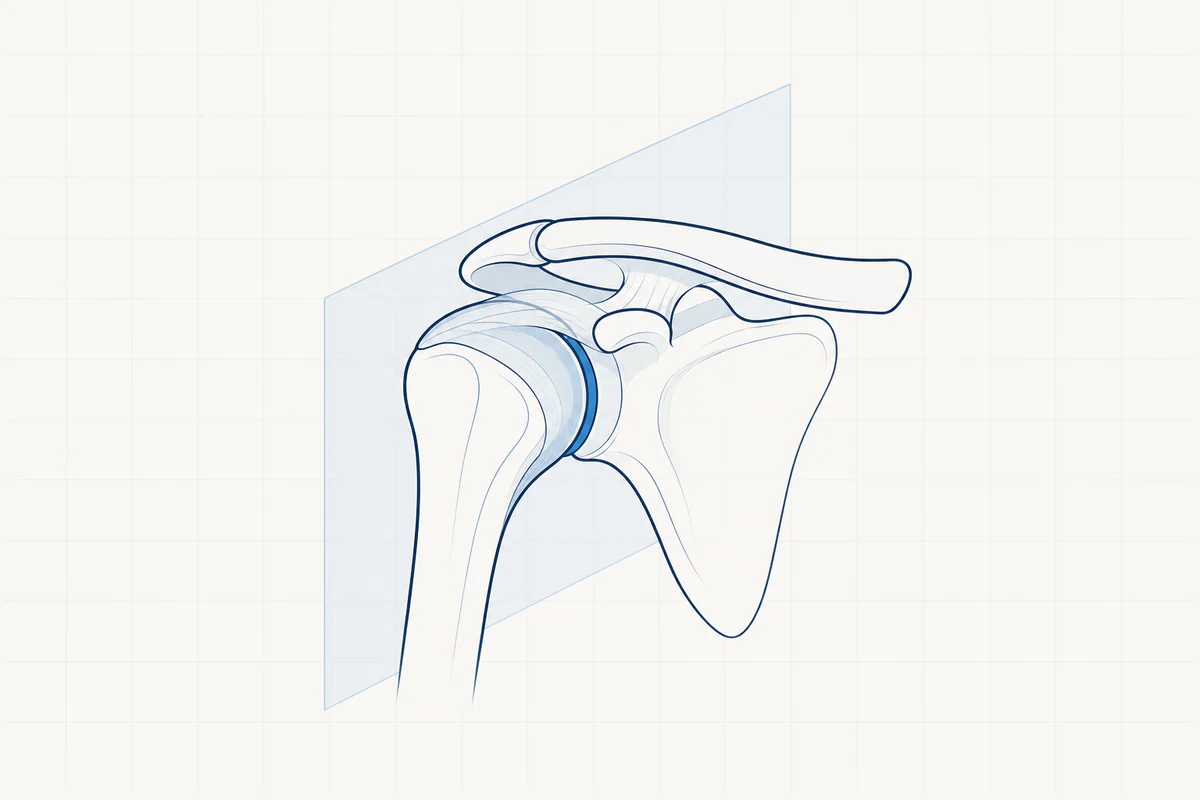
The shoulder is a complex joint with the greatest mobility of all joints in the human body.
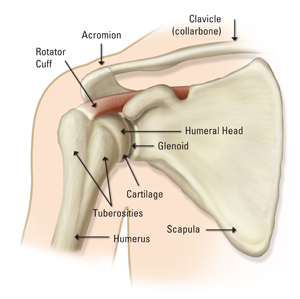
Het schoudergewricht bestaat uit twee beenderen: de kom van de schouder (glenoid), die deel uitmaakt van het schouderblad, en de bol van de schouder (caput), die deel uitmaakt van de bovenarm. Het is een kogelgewricht waarrond verschillende grote schouderspieren vasthechten, waardoor de arm in de ruimte kan geplaatst worden.
Both the pan and the bulb are covered with a layer of cartilage to allow smooth and painless movement between the two bone ends.
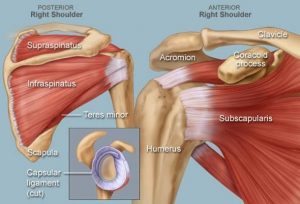
The roof of the shoulder is formed by a part of the scapula called the acromion. The acromion is in turn connected to the collarbone.
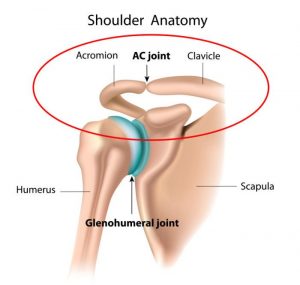
So 2 joints form around the shoulder girdle:
The shoulder joint or glenohumeral joint itself is formed by the humeral head and the glenoid (pan).
The joint between the collarbone (clavicle) and the roof of the shoulder (acromion): the acromioclavicular joint or the AC joint.
LIGAMENTS or JOINTS
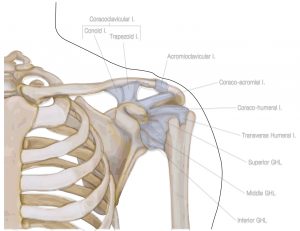
The shoulder is a very mobile joint. There is therefore a great need for strong ligaments to stabilize the shoulder joint and prevent possible dislocation. Ligaments are connective tissue structures (“cords”) that connect bony structures. The joint capsule of the shoulder is formed by a group of ligaments that connect the ball (caput humeri) to the pan (the glenoid). Another important group of ligaments provides the connection between the acromion and the collarbone. There are also ligaments between the collarbone and the front of the shoulder blade. These are important for the stability of the AC joint.
MUSCLES and TENDONS
Muscles are elastic and can contract so that 2 bones can move relative to each other in space. The tendon is the end that attaches or anchors the muscle to the bone.
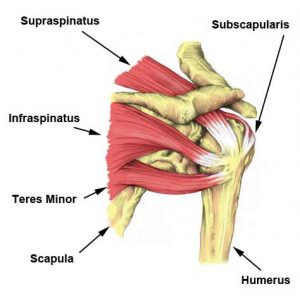
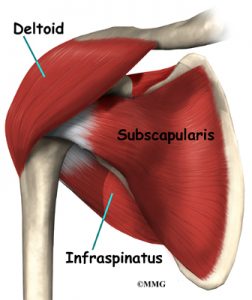
The main muscle group or engine of the shoulder is the rotator cuff. The rotator cuff consists of 4 muscles (Supraspinatus, infraspinatus, subscapularis and teres minor). The tendons of the rotator cuff muscles are attached to the upper arm around the humeral head. The rotator cuff muscles ensure that we can lift our arm forward and sideways, but also that we can rotate our upper arm (external rotation and internal rotation). These are very important actions in daily life (e.g. washing your back, combing your hair, eating, etc.). In addition, the rotator cuff muscles are also crucial in the stability of the shoulder joint by keeping the ball in the pan.
Inside the shoulder joint, the long biceps tendon attaches on top of the pan of the shoulder. The biceps muscle has 2 tendons: the long and short biceps tendon. The long biceps tendon runs downwards in a groove (the biceps groove) and is stabilized in this groove by a transverse ligament, the transverse humeral ligament. The long biceps tendon is a very frequent source of shoulder pain.
The outer muscle layer of the shoulder is formed by the deltoid muscle. This is the largest and strongest muscle of the shoulder joint. The function of the deltoid muscle is to lift the arm forward, sideways and backward.
SLICE FAIRS
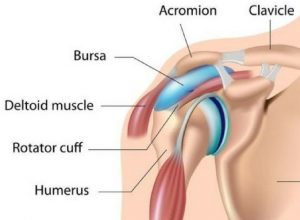
A bursa is a small sac filled with a small amount of joint fluid (lubricant). The bursa at the shoulder prevents the friction of the rotator cuff tendons against the roof of the shoulder.
Frequently asked questions

Orthopedisch chirurg – AZ Jan Palfijn Gent
Specialized in shoulder and knee surgery
The information on this page was prepared by Dr. Yves Depaepe and is intended as general medical information. Always consult your doctor for a personalized treatment plan.