DR. DEPAEPE
1. WHAT
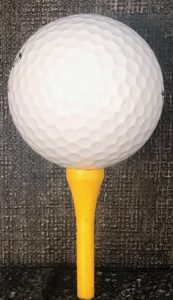
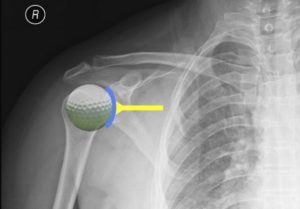
The shoulder joint is a very mobile joint. We can compare the shoulder ball and the shoulder socket to a golf ball on a tee. The price we pay for this great flexibility is “instability”.
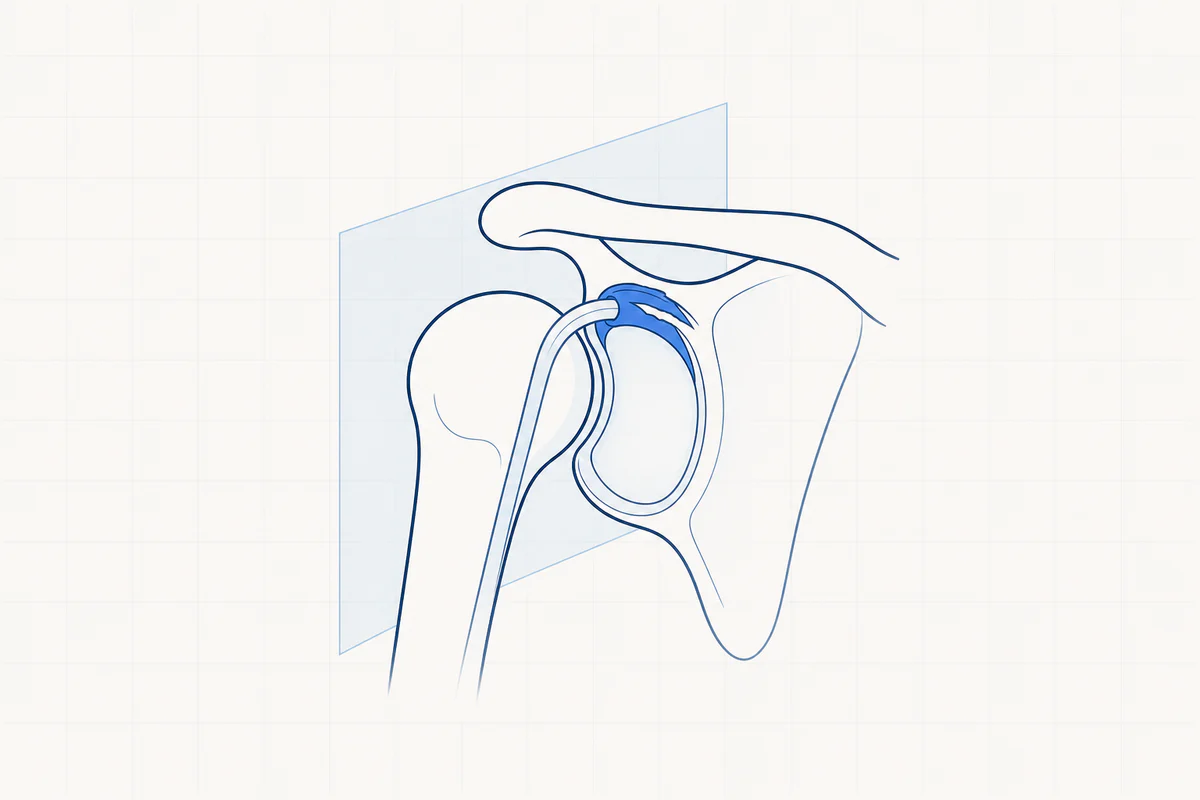
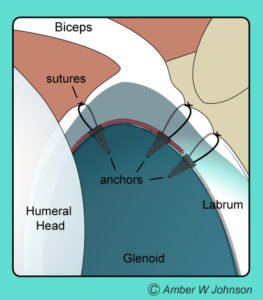
To guarantee the stability of the shoulder in normal circumstances, we have a sturdy membrane around the shoulder (capsule) containing strong reinforcing ligaments (ligaments). In addition, there is a firm, upright cartilaginous ring around the socket, to which the capsule attaches. The long biceps tendon attaches to the top of the socket of the shoulder (glenoid) and continues into the upper part of the labrum (biceps anchor).
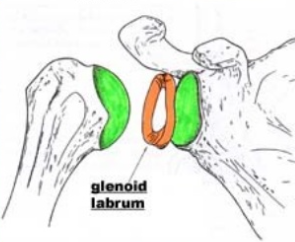
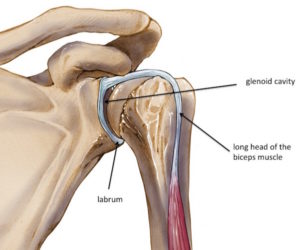
A tear at the attachment of the long biceps tendon, extending into the labrum to the front or back, is called a flaccid injury (Superior Labrum Anterior to Posterior).
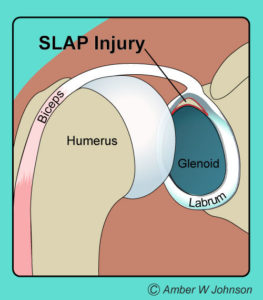
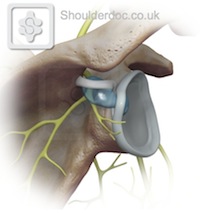
Sometimes this injury occurs after dislocation and this tear injury is accompanied by other tear injuries in the labrum (Bankart injury). Active link to bankart in case of instability
Bij lang bestaande scheuren, ontstaan soms cystes (paralabrale cystes). Deze cystes kunnen soms druk geven op zenuwbanen bv. nervus suprascapularis.
2. CAUSE
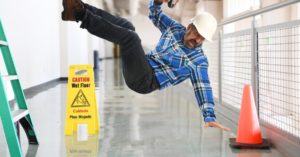
- A fall on an outstretched hand.
- Sudden pulling force on the shoulder, e.g. reflex of moderately grabbing a weight that is too heavy.
- Sudden force on biceps tendon during overhead activities.
- In case of dislocation of the shoulder.
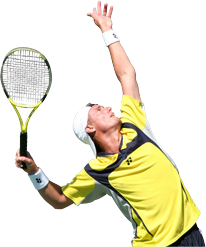
- Repetitive movements above shoulder level e.g. serve in tennis, volleyball, ...
3. COMPLAINTS
- Vague deep pain in the front of the shoulder.
- Pain increases when moving above the head.
- “click” in the shoulder, there is a feeling that “something is jumping”.
- Loss of shoulder strength when throwing or lifting.
- Feeling of a very tired arm or “paralyzed” arm when playing sports above shoulder height, e.g. tennis, volleyball, etc. (dead arm syndrome).
4. EXAMINATIONS AND DIAGNOSIS
During anamnesis, the description of the typical complaints often already suggests the diagnosis.
Bee clinical research Specific tests are often abnormal by the doctor, which leads to further imaging.
One Arthro MRI scan (MRI scan with prior contrast injection): injection of the contrast fluid often makes the tear in the labrum much more visible. This way we are able to distinguish different types of cracks.
Keyhole surgery. If uncertainty persists, keyhole surgery with direct testing of the labrum can confirm the diagnosis.
5. TREATMENT
In the initial phase, non-operative treatment is always attempted, unless the injury is of such magnitude that only surgical treatment can improve the condition.
Non-operative treatment
- Rest, temporarily interrupting stimulating sporting activities.
- Anti-inflammatory medication.
- Injection. Various options can be discussed (cortisone, hyaluronic acid, PRP) to control pain and inflammation.
- Physiotherapy with a focus on restoring mobility, recovering strength and coordination of the shoulder muscles.
In some patients with labrum tears, the symptoms can sometimes diminish greatly over time and even become almost pain-free.
Operative treatment
In the case of traumatic and especially repetitive traumatic dislocations, there is a good chance that surgery will be necessary.
The type of surgery performed depends on:
- The size of the lesion and the quality of tissue
- The number of dislocations
- The age
- Sports and professional activities
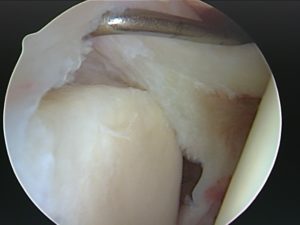
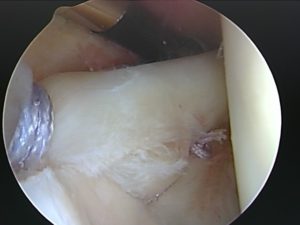
Keyhole surgery: arthroscopic slack suture
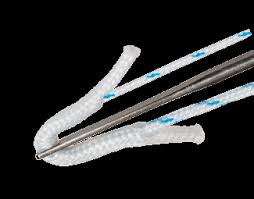
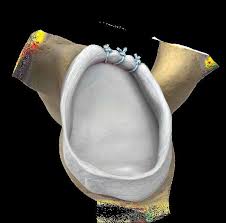
The torn labrum is reattached to the bony part of the shoulder (glenoid) via keyhole surgery. This is done with special “bone anchors” with special wires attached to them. In this way, an attempt is made to return the labrum with the biceps anchor to its original position under the correct tension. These anchors do not have to be removed later.
Keyhole surgery: arthroscopic debridement
Sometimes the quality of the labral tissue is not strong enough to perform a correct suture (aspect of a frayed elastic). Sometimes the chance of good healing after suturing is also reduced due to, for example, age, smoking, diabetes, ...
In these cases a “debridement” performed from the affected labrum. The torn labrum is “trimmed” (shaved) to smooth edges.
If we choose this option we must also choose one associated treatment on the attached biceps to release tension on the labrum.
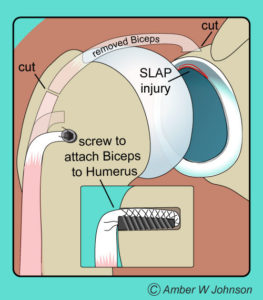
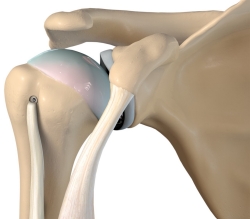
Biceps tendon tenodesis
The biceps tendon is released at the attachment to the labrum and reattached a few centimeters lower on the upper arm (humerus). In this way, the tension on the attachment of the labrum is removed and the pain disappears. The disadvantage is that the new attachment point of the biceps also needs to heal and grow in. This growth phase is often accompanied by more long-term pain complaints and delayed rehabilitation. In this rehabilitation phase, the biceps must be protected by wearing a shoulder bandage for a longer period of time to guarantee growth.
Biceps tendon tenotomy
De biceps wordt losgemaakt ter hoogte van de aanhechting van het labrum en nadien niet meer terug vastgehecht. Dit lijkt een radicale en onlogische handeling, maar is in de meeste gevallen de beste keuze! Gezien geen noodzaak tot bijkomend ingroeien of vastgroeien, kan de revalidatie zeer snel worden opgestart. Dit verkleint heel sterk het risico op een frozen shoulder! Zoals we misschien zouden verwachten, brengt dit weinig tot geen krachtverlies met zich mee. Enkel bij mensen die repetitief zeer zware fysieke arbeid uitvoeren, is er in de eerste maanden wat meer vermoeidheid in de biceps spier met nadien soms wat krampachtige pijn.
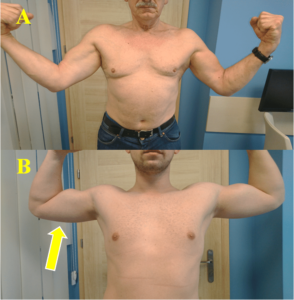
There is currently no evidence in the scientific literature worldwide that a biceps tendon tenodesis is better than a biceps tendon tenotomy. Only the reported complications of a tenodesis (insufficient union, persistent pain, infection, longer rehabilitation, etc.) are much higher. However, there is an aesthetic difference, whereby with a tenotomy the “forsbal” is positioned somewhat lower. The choice between tenodesis or tenotomy depends on various factors, type of injury, quality of tissue, age, profession, sport, etc. But ultimately, the choice between tenodesis and tenotomy is not a choice about function or strength, but merely an aesthetic choice.
ANESTHESIA AND HOSPITAL STAY
The keyhole surgery is performed under a short general anesthesia in combination with a local anesthetic (interscalene block).
After the procedure you will stay in the hospital for 1 night.
6. COMPLICATIONS
- Tearing again. After complete healing, the labrum can tear again in the event of a (sports) accident.
- Decreased mobility. This occurs in the first phase after stitching and disappears with time. Movement limitation may also be present in the initial phase of a biceps tendon tenodesis.
- Infection is almost non-existent during keyhole surgery.
- Pain. With biceps tendon tenodesis there is sometimes persistent pain at the site of attachment.
- Deformation of the “forsball”. This is present if a biceps tenotomy was performed, but this does not lead to permanent pain or loss of strength.
- Thrombophlebitis or damage to a blood vessel or nerve are theoretical complications but in reality very rare.
7. REHABILITATION
After the operation you will wear a shoulder brace for 4 to 6 weeks.
The attached labrum must grow back to the bone of the socket of the shoulder. This process takes about 3 months and during this period the shoulder is vulnerable.
The physiotherapy is done according to a given schedule. The timing of the start depends on the size of the injury and the surgical technique performed. We often wait 2 to 4 weeks before starting physiotherapy. During your hospital stay, you will be taught exercises that you can perform independently at home.
We do try to limit all exertion during the first 3 months. In particular, strain on the biceps tendon should be avoided.
Recovery time varies greatly from patient to patient! For large complicated cracks, the repair time can take several months.
8. FACTS
Try the pain controlled with prescribed painkillers and ice applications.
Love the wounds clean and dry. Showering is allowed with a shower plaster (opsite, tegaderm, ..)
The stitches can be removed after 14 days by the home nurse or your GP.
Disability ligt tussen 6 weken en 4 maanden en is afhankelijk van de inhoud van de job. Bespreek dit voor ingreep met uw arts.
Driving. You can start driving when you feel that you can easily steer with both hands without any problem. To do this, you should be able to comfortably raise your arm above shoulder level. For most people this is about six to 8 weeks after the procedure.
Sports resumption. Your physiotherapist and surgeon will advise you when it is safe to resume your hobbies. This will depend on the type of sport and the level at which you practice it.
- Weeks 1 to 6: no sports, only entertaining cardio training can be allowed (e.g. exercise bike or treadmill).
- Week 6 to 16: walking, cycling and swimming (breaststroke first) can be gradually built up within the pain threshold.
- Week 16 to 24: sport specific training for contact sports and ball sports can be started.
- From 6 months after the procedure: a return to competition can be planned.
Frequently asked questions
Orthopedisch chirurg – AZ Jan Palfijn Gent
Specialized in shoulder and knee surgery
The information on this page was prepared by Dr. Yves Depaepe and is intended as general medical information. Always consult your doctor for a personalized treatment plan.